Learning a Language is Such a Beach

“This we-wee-weekend I’m going to the BE-BEECH.”  At that moment her face turned red and her eyes darted around the room to see the reaction of the other students.  There were a few raised eyebrows, some half hushed gasps, but more importantly, an ensuing silence that only Donald Trump could break.

I had just asked what their plans were for the weekend.  It was a hot, somewhat stuffy Saturday morning  in San Ramon and I was leading my weekly English conversation group.  The students come every week as they are motivated to get guidance on their English conversation skills and are very supportive of one another.  The reaction to this comment though, was perplexing.

Something was going on here, like an inside joke that I was not let in on.  My haunch was that it was a cultural or lexical detail that I had missed.  If only my wife were here to whisper the answer into my ear…  Well, that was not going to happen, so I quizzically began to study the students, looking from one to the other, trying to get one to share their reaction. 

Class teaching
                    B-e-a-c-h, /beach/

Eventually, one shared, “Teacher, how do you say BEECH?”.  Now we were getting somewhere.  “Well, it’s pronounced ‘beach’”. I responded.  Mildly puzzled, they countered, “and how do you say BEECH?”.  Hmmm, hadn’t I just explain it?  Or am I going to need a visit to the ear doctor?    

I still wasn’t following what they were asking so I prodded,  “What do you mean by BEECH?”  I asked.  The response I got was in Spanish and was something along the lines of someone doing sexual acts for money.  Then it hit me, and not wanting to take the conversation any further off course than necessary, I followed up with “Oh, you mean a female dog, don’t you?”  Receiving an affirmative head nod I was finally back in the game and could take the reins of the group again.

The hold up was that the “bi” sound sounds like the “be” sound in beach when pronounced in Spanish and is why Spanish speakers tense up when using this vocabulary.  I would too, knowing the consequences of any little mistake.

I’m proud of the students for coming and having the courage to bring their language concerns to me, even at the expense of embarrassment.  I was in their shoes too, and the best way to never forget a word is to have a memorable moment using it.

I’ll never forget, when having dinner with my very first host family, I made a grammar mistake and they corrected me.  It was a simple mistake that I should have known, so I apologized by saying how embarrassed I was.  This response though incited laughter from the family because I had made an even bigger error.  I assumed embarrassed translated roughly to “embarazado” like so many other English words.  The word did exist, but it meant I was pregnant. 

Or the time my friend learned how to make tortillas and proclaimed she was a tortillera.  She made this claim assuming the nouns could be used for people (example: a carpenter does carpentry, a plumber does plumbing etc).  She was right about the word existing, but didn’t realize that locally, it meant she was a lesbian. 

Moments like these I’ll never forget as I assure myself that I’ll always be the “person that makes tortillas”.  I’ll never be mistakenly pregnant again, but I’m sure I’ll still make the same small grammar mistakes.

We only meet for a few hours on Saturdays to informally chat in English, but this discussion will probably stick with them long after the sessions have concluded.  These students already have a good handle on their English and they use me as an open book for detail work.  We spend a lot of time going over these details and often times discover new nuances we never knew existed.  Did you know if you really fudge the pronunciation of ‘beer’ you can make it sound like ‘mirror’. 

I might have to invest in a dictionary or really study up on pop culture as these students will push you.  I can’t think of a better way though to uncover language’s best kept secrets than in a dusty, glorified storage room with a group of eager apprentices.  The opportunity they have is something that if I had had, probably would have saved me from some “enlightening” experiences to say the least.   

So the next time you are in Costa Rica, or any Spanish speaking country in Latin America,  think back to this article before you tell the locals you’re going to “hit the beach”.

Thanks for reading this blog and feel free to share your comments.  Have you ever had an embarrassing language moment?  ¡pura vida!

All Abroad: My Immersion Experience (Guest Speaker)

I couldn’t believe I was actually doing this.  The plane had just touched down in San José, Costa Rica and here I was, all by myself with my life packed into two little roller bags about to exit customs and head out into the unknown.  I was met with the blur of what seemed like a thousand paparazzi shouting at me, hands in the air, waving signs and trying to get my attention.  I was dumbfoundedly looking around for my name, when all of a sudden a man came up to me, said something very fast and proceeded to grab my bags and walk away…

As they say “the rest was history”, or was it?  To hear inspiring personal travel abroad stories, cultural immersion experiences, and exchange anecdotes, join or invite Dustin to speak to your group/schoolperson with 2 dogs.

Speaking dates are available year round (virtual) and in person dates are subject to availability.

Upcoming in person speaking opportunities in Wisconsin:

Oct. 24th – Nov. 3rd, 2016

Jan. 23rd – Feb. 1st, 2017 (exchange groups)

For more information contact us

Why not Embrace Monolingualism?

howler monkey hanging out

Author’s note: About a month ago I shared a piece written by my sister as it related to something I’m quite familiar with in Costa Rica.  Her thoughts were spot on and I totally thought the same, that learning languages opens up a whole world of opportunity (especially if you have to learn English).

I got to thinking though, and began to ponder, however, just what the world might be like if there was only one, universal, language.  This post started off as a fun, light-hearted jab at all the promotors of bilingualism (myself included).  However, the more I got into to picking arguments to justify the contrary, they didn’t seem as far fetched as I’d imagined.  I’m not sure I sold myself on the monolingual platform (languages are just too fun not to have) or if I’ll convince you, but it is interesting to analyze what a mono-world might look like.  Discussion/comments welcome 🙂

The first time I heard the term “monolingualism” used in the noun form (-ism ending) was about a month ago in this very same space.

It wasn’t a surprise that the author, my sister, would use a high-register, lexical term to send me running to the dictionary to find out what I was missing.  In promoting not speaking one language, she opened the proverbial “can of worms” in my head. Needless to say, there are two sides to every story, and even though we both chose to live in diverse, Spanish speaking countries, it seems we should be able to bend on the language aspect.

I’m not sure we really need more languages in our life.

If we break down the word “mono-lingual-ism,” we’ll find the prefix “mono” in Spanish translates to monkey.  If you’ve ever been in a forest and witnessed a pack of monkeys passing overhead, you’ll see they have it pretty good.

The alpha leads the pack and watches for predators while the mothers follow behind with their young ones. There is plenty of monkeying around for the teens and the noises they make are mostly squeals of varying degrees, but the understanding is there. Rarely do you see a monkey away from its troupe.

In all seriousness though, if monkeys can do it – and they’re close relatives to humans – there’s no reason we shouldn’t be able to all agree on one language.

Think of the possibilities. Travel would instantly open up to all parts of the world and the connections made would be a lot more meaningful. No longer could someone rule out the Basque country because they don’t speak Euskera, and think how much more you could learn about another culture being able to understand it without relying on a filtered translation?

There would probably be fewer wars, and not that my mother-in-law would be interested, but at least she could knowingly nod in agreement when the Macy’s lady at the mall asks her if she would like to apply for a Macy’s card. She could even respond “Thanks, but no thanks.”

And with that, I think I just stumbled upon the economical ramifications of monolingualism.

Imagine all the business that could be done with one language. Granted, you could argue that this already exists with English being the proclaimed the world’s business language, but imagine being able to launch marketing campaigns in any country without having to translate.

Right now, if you want to see “The Conjuring 2” but happen to be in Costa Rica, you’ve got a problem. It’s bad enough you aren’t sure if it’s /kan/ or /kon/ -juring in the English pronunciation, but then think of the shame and possible humiliation trying to ask for tickets to “El Canjuro Dos.”

Besides that, it would be great to do away with all subtitles and horribly dubbed TV shows/movies. Remember when Psy broke YouTube with “Gangnam Style”? Just imagine how many more views it would have had if the lyrics could have been understood by more than 1.2 percent of the world’s population.

According to vistawide.com, there are approximately 71 million Korean speakers in the world, but at latest count “Gangnam Style: has just under 2.6 billion views on YouTube. There’s a simple explanation for how that has brought so many people to the same place: Music, like numbers, is universal.

Everyone can understand music, and apparently if the beat is catchy with a dash of humor and/or goofiness, you can reach billions. YouTube would argue the same, as 28 of the 30 most viewed videos of all time are music videos. So if music can unite us universally, language should, too.

If you aren’t born with the preferential language, you face an uphill battle to get it, and the costs can be quite high. Even in Costa Rica, a country that teaches English K-12, most students graduate shaky at best. What’s even more concerning though is that knowing English is not even enough.

A few years ago, San Ramon was buzzing because a new call center had just opened and had tons of positions to fill. Even I was excited, as this could be a potential job opportunity for me. But when I went to the job fair to get more information, I was astonished to hear the starting salary: just barely more than the required minimum-wage pay per month.

So applicants were basically better off cleaning bathrooms at a public institution and not spending their money on language classes.

Let’s face it: We’ll all have to have the world’s language as soon as we can. You shouldn’t waste time being taught the language in a classroom. Literally, you need to be born with it, because speaking it alone won’t get you ahead. You also have to be able to do something with it.

So instead of arguing against monolingualism, let’s argue for a world language. It won’t be easy, but maybe there’s some combination of singing and gestures that can unite us all in common understanding.  I nominate Psy and a pack of monkeys to get to work on it.

Rebel Cattle Herding in Costa Rica

(Note: I really wish I had some pictures to go along with this post.  You’ll have to use your imagination to get an idea as to what was really going on.  Most days I go for a casual walk/run and don’t end up on wild goose chases.)

One of the great things about San Ramon being a fringe town (‘fringe’ being that it is far enough away from the big city to not be plagued by crime and safety issues but close enough to not get bored ex. has a food court, a shopping (s)mall and a movie theater) is that the countryside is not far and a 5 minute walk outside my front door puts me into the rolling foothills amongst sprawling coffee and sugarcane plantations.

It was a lazy Saturday morning and I needed some air so my wife and I decided to journey into the plantations and do a little exploring.  My wife’s uncle had just purchased 2 cows that he had planned to raise as beef cattle.  He had purchased an expensive breed and had proudly brought them to the family farm, nestled in amongst other family farms, forests and some residential homes.  What he hadn’t anticipated was how rebellious they could be.  After locking them into their corral Thursday evening he returned Friday morning to find one missing.

He immediately called my mother in law worried as there was no noticeable damage done to the corral to indicate the cow had forced itself out.  Maybe it had jumped the fence?  Maybe a crime ring looking to satisfy the prime rib black market had come by?  It was all so strange because in either scenario why would there still be one cow left?

With that on our mind our walk through the plantations took on a new objective.  At every clearing we combed the landscape for a lonely cow and every piece of excrement we encountered required in depth examination.  We even had to keep our dog from getting to far ahead of us in order not to disturb any possible footprints.  Despite our efforts we saw no trace of the renegade cow and dejectedly headed to the corral to complete our walk.  As we were approaching there was a neighbor’s sugarcane plantation to our right.  March is prime harvest time for the sugarcane and this field had just been cleared giving us excellent visibility.  I was half-heartedly scanning the field when I saw a head bob right at the edge of the plantation where it meets the forest.  It was almost as if the cow was actually trying to hide itself as the second I paused and focused on her, she froze instantly.

We were still a good 60 yards away and had no way of corralling her so we decided to short way back to the corral and deliver the good news to my wife’s uncle.  When we arrived though we were greeted by a different scenario.  The uncle wasn’t there, the gate to the corral was badly damaged and worst of all there were now no cows in the corral at all.  Turns out we were only saving our uncle from a second major headache as we had found the second cow which everyone to this point had assumed had not escaped.

Just then the uncle came out from the nearby forest cussing up a storm and not even our news seemed to calm him one bit.  He just seemed to snarl and say “Well come on, what are you waiting for, let’s go get the cow!”  If that didn’t tell me I was family now, I don’t know what will.  So off we went the three of us, with two of us having absolutely no experience herding any type of farm animal much less one that was predisposed to run from us.

So the plan seemed pretty simple, we would separate around the cow and then attempt to converge on it and funnel it back towards the corral.  Our first attempt failed as I apparently failed to maintain edge containment.  I thought I was doing a pretty good job but I guess needed to be faster on the edge, and he let me know “CORRA! CORRA!” (Run! Run! explicative, explicative….).  It reminded me of working with my father when I was younger and him getting frustrated with me when I just couldn’t visualize the objective he was after even though it was second nature for him.  I had to bite my tongue to keep from laughing at the predicament we were in as I honestly didn’t know what I could have been doing better.  Eventually the cow tired and we were able to get a lasso on her and lead her back to the corral.  Unfortunately we still had the missing cow and a damaged gate.

This is where a picture is worth a thousand words.  Not knowing what to do about the gate but having rope and some wood planks at our disposal we put together the most makeshift gate together you’ll ever see.  I thought I would be in for a treat observing how a Costa Rican cowboy gets by in the wild but we ended up putting up and taking down the temporary gate three times before we found a design that would keep the cow from getting out.  It wasn’t pretty but did the job.  I guess not everything is second nature when it comes to farming.

A few days later the other missing cow magically showed up back at the corral on her own.  I’m not sure if she planned to do this or maybe she just got bored wandering around the farms.  The next day my wife’s uncle took them back to the auction and sold them.  If I had to guess I’d say he’s learned his lesson about this breed and that there might be a very good reason as to why they are more expensive than your average cow.  Luckily, neither cow got injured or stolen while they were out on the town.

Thanks to living in a fringe town my walks are able to cover not just urban areas but also nearby rural zones which can be quite diverse.  I’ll have to be on lookout the next time I go out as you don’t always find the things you are looking for but rather find/discover things when you’re not looking for them.

My First (Official) Cultural Exchange

cultural exchange shirt with signatures

I was excited for the 1:30am wake up call.  It didn’t matter much since the anticipation was so great to begin with I knew I wasn’t going to sleep much anyways.  Today was day 1 of the Costa Rica – Wisconsin high school exchange.  18 hours from now we’d be in a snow frosted parking lot, temperatures in the teens, and students darting off the bus into their host families arms not only to greet them after months of emails and phone calls but to receive hats, gloves, and winter jackets, all scarce in the tropics.

For me this was a homecoming exchange in the fact that my alma mater and hometown was playing host to this exchange.  With them providing the families that would adopt the visiting students for the next two weeks and inviting them to school for a few days, the exchange had its firm foundation from which to work from.  Even my parents were delighted to be hosting their son and daughter in law for two weeks.  From there students could explore their surroundings and see all that snowy Wisconsin had to offer.  It didn’t take long for us to hit the ground running.

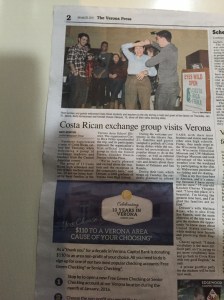
Just our second night we hosted a welcome event for the exchange families and community to come together and get to know the students.  Very few anticipated the number of interested community members that would turn out for this event and almost

IMG_2516
Big news for small town 🙂

no one expected the local newspaper to be there taking pictures and interviewing.  I was however very proud of the group as they showed no fear in making a small presentation about Costa Rica to the audience and even treated them to a mini salsa recital.


With cultural exchange activities and English language practice being our objectives we took in everything I’d been lacking since my childhood and then some.  Sledding and ice skating were at the top of our list but even activities such as ice fishing were prominent memories for the group.  And by group I include myself and a lot of the host parents/siblings as not all of us grew up ice fisherman. We pretended to stand on the ice and look knowledgeable during the demonstration to not lose face in front of the students.  Between these events, schools visits and family time the experience ended up turning into one of a lifetime.

I couldn’t help but notice the bonding going on between the local and visiting students.  Watching them explain how to skate or how to get maximum velocity on a sled was emblematic of the whole experience.  Every day the students would get together to share stories and funny experiences they had.  The amazement of the lack of rice and beans present in a Wisconsinites diet, the wonderment of how cows stay warm in the winter and how ice could form so strong that someone could walk on it, let alone drive a car on it were just some of the conversations had between students and their hosts.

Some people wondered why we chose to come in January.  Costa Ricans know what summer is all about but why not choose spring, or fall?  Well to begin with we were limited

IMG_2456
First time for everything!

due to the summer break in Costa Rica being Dec/Jan but to find the most diversity and biggest departure from the norm winter is what it has to be.  None of the Costa Ricans had seen snow before this trip and I don’t feel a bit of regret facilitating this experience.  Wisconsin does not have coffee plantations, volcanos, rainforests, or beaches that are within an hours drive of each other so we have to get creative with own nature and natural beauty.  Sure you’ll find a big enough cultural difference but the difference in climate is literally the icing on the cake of a winter exchange to Wisconsin.


I don’t believe the impact of this experience really set in until it was actually over.  We had gotten into this routine and we felt like it was never going to end.  But it did and the realization was almost instant.  When we boarded the bus to head back to the airport my

IMG_2536
Who could forget this?

phone began to explode with host parents and students expressing their gratitude and happiness with the experience.  As that was going on the Costa Rican parents were anxiously messaging us about travel plans and flight arrivals. 14 hours after bidding farewell to Wisconsin the students were back in the arms of overjoyed parents.


I think back now to the first meeting I had with parents in the fall and all their quizzical looks and even the parent who point blank asked me if I had children (I don’t).  Leaving that meeting casted some doubt on how I could ever convince a parent it was safe for them to send their child with me to a foreign country and to stay with a family they had never met before.  I could stand before them and give as much assurance as I could but until I have my own no one is really giving me the benefit of the doubt which is why host families make the exchanges so magical.

Whenever I talk to students and host families I can’t stress how important they are in the success of an exchange.  Months and years later a student doesn’t remember falling while ice skating or building a snowman but they do remember who they were with.  You might go on vacation or take an educational tour but there is no better way to learn about the place you are visiting than experiencing it with a local.  These bonds, created with the goal of learning one’s culture stay with us much longer than a week spent at an all inclusive resort where asking for a cerveza from the wait staff qualifies as culture.

With technological advances students and families can live the experience through each other, even if they are not actually on the exchange.  Every school we visited and every

IMG_2538
Hi mom, I’m on Wisconsin!

activity we did there was an opportunity to snap a photo and share it with all of the Costa Rican parents.  Watching a hockey game, participating in class, or even eating at food court, parents were able to see what we were up to and that was very reassuring for them.  Combining that with the pre-trip communication they had with their host family via email and video calls everyone felt confident with the trip and this was the backing I needed to convince parents my empty nest was not a cause for alarm.


At the end of the two week whirlwind trip I could have slept through four alarms having maxed out all the energy in my body.  As I write this now a month has gone by since the exchange ended and recalling all these fond memories provokes the same excitement all over again.  This inaugural exchange couldn’t have gone better and I’m hopeful to carry over these positive vibes to many more exchanges in the future.

What a difference Guatemala makes Part 3

This blog typically is directed at all things Costa Rica however I had the unique opportunity to spend a week in Guatemala (a neighboring Central American country to the north of Costa Rica).  This is the final part of a series of posts that will cover my week long trip. You can read part one here and part two here.

It was about 9:30pm and I was just about to doze off in my hotel room.  The next day we had to depart at 6:30am in order to get to our village visits so I was looking for one of those “early to bed, early to rise” nights.  With the TV on low and my consciousness slowly fading into dreamworld I was promptly started by the sudden ringing of the room phone.

“Hi Dustin, please come meet the group in the lobby.  There has been a change in plans.”  Well this had interesting written all over it.  Living in Central America you become used to things that would never be a concern in the US.  As a University Construction Management student I remember reading through construction contracts and chuckling about acceptable reasons for finishing a project past its due date.  Hurricanes, war, strikes, political protests.  Yeah, like those things were ever going to happen so much that it would disrupt a construction project.  Well those things are very real here.

Most places only have one route to get there.  If there are detours they are a good 3-4 hours.  So any of these things could quickly throw a monkey wrench into everything.  Sure enough there was going to be a strike the next day that planned to block all the highways leaving Guatemala city.  Why were they blocking the streets?  Who were the culprits?  You might be a little surprised to hear that the government hasn’t been paying their doctors since July.

This might seem unheard of that a government would not pay their employees.  Actually last year in Costa Rica teachers went on strike for one month because some of the teachers were not getting paid.  Some.  They interrupted the school year for one whole month before the government got their act together.  And there were various days when roads were blocked in protest.  In the end all everyone got paid, even for the month they were on strike and there was no reduction in vacation time or extension of the school year due to the strike.  Everyone won except the senior students who had one less month to learn and prepare for the national exam that they needed to pass in order to graduate, but I digress.

Who knows how the Guatemala doctors will fare but I was not the least bit surprised by the situation so when our departure time got pushed up to 2:30am in order to avoid the blockade I thought well at least we would avoid the morning rush hour.  I have to say though it could have been worse.

That same night on the news we heard of some schools that weren’t being allowed to teach because some neighborhood gangs were threatening them that there would be violence if they didn’t pay them 15 thousand dollars.  I never figured out why they wanted that money but it probably wasn’t a very good reason.  Nevertheless I’m very content that the most I’ve had to deal with in Costa Rica are peaceful marches and roadblocks.

Throughout the course of these posts a lot of things have swung in Costa Rica’s favor however one obvious advantage Guatemala has over Costa Rica is its transit system.  The main highway that runs through Costa Rica connecting Nicaragua and Panama is primarily a two lane road, one lane for each direction.  If you’re lucky you might have a passing lane on some of the steep uphill climbs but keep your guard up because those lanes are closed in random spots from mudslides that happened years ago that the government has never repaired and doesn’t plan to repair them.  Not so in Guatemala.

All the main highways going in and out of the city are 4-6 lanes and there are always additional passing lanes for the uphill sections.  Mudslides are just as common as in Costa Rica but when they happen the government is there to clean it up quickly and re-open the lanes.  They still have too many cars in the city but what big city doesn’t have traffic issues?  My only concern was feeling sick from inhaling all the fumes sitting in idling traffic.  Besides that the only other issue I had with the roads were the number of speed bumps.  This is really the only way to control speeding in Central America but it was a little over-exaggerated here.  Usually when you get to a school zone you have one bump at the beginning of the school and one at the end however in Guatemala they would have like four.  And for the manual car drivers, they were spaced just far enough apart so you would have to shift from first to second gear just for a second before arriving to the next bump.

Weather/Geography

Both weather patterns are quite similar with a rainy season and a dry season at pretty much the same time of year.  Guatemala is in the hurricane zone whereas Costa Rica is

Cooler climate, but excellent look out points
Cooler climate, but excellent look out points in Guatemala

not.  From what I saw the majority of Guatemala is drier than Costa Rica (similar to the Guanacaste region).  They have higher elevations and are situated further to the north so it can get colder than in Costa Rica.  When I was there the last week of January there were some places that got below freezing at night.  That never happens in Costa Rica.  Due to this it wasn’t surprising to not hear much talk about beaches.  One of the crown jewels of Costa Rica, however if you ask a Guatemalan about beaches they’re likely to tell you about the beach trip they took…. to neighboring country El Salvador!

Economy

In the short time I spent in Guatemala I would have to say tourism and agriculture are a big part of the economy, which is quite similar to Costa Rica.  Both countries grow lots of coffee too.  One thing I noticed in Guatemala is there are not a lot of industrial coffee processing.  A lot of the coffee is sun dried whereas in Costa Rica they have mechanical ovens that can dry the coffee quickly in addition to sun dried.  The sun dried process takes a few days but the quality is better.  In this sense Guatemala might be a little more of a “I’ll get to it mañana” country than Costa Rica.  Other than that you will see a lot of corn being grown in Guatemala.  We planted fruit trees in some of the rural villages we visited to help diversify their diets because everything they were eating was corn based.  You’ll see corn in Costa Rica too, but sugar cane, bananas, pineapple, etc all have their growing zones as well.

To conclude my little Costa Rica-Guatemala series I’d like to talk about the culture.  My wife is Costa Rican and her and her parents joined me on this trip.  It was very interesting to see how they interacted with the locals and to hear their opinions about the culture.  They shared some of the same reactions as to why they would live so remote but were very curious to learn about how they lived.  My in-laws grew up on farms and were able to teach the Guatemalans about farming.  Some of them knew so little that they weren’t even sure how to plant trees or seed a garden properly (not that I knew any of that either, but at least I know I have the resources if I ever plant my own garden).

I have to say both cultures pride themselves on their friendliness.  The Guatemalan accent is very sweet and inviting and even though the Costa Rican accent is distinct it is filled with “honeys, sweeties, and cuties”.  There seemed to be an ongoing battle between who could be the most polite and sweet.

One astonishing thing that is echoed throughout many Central and South American

Traditional dress
Traditional dress

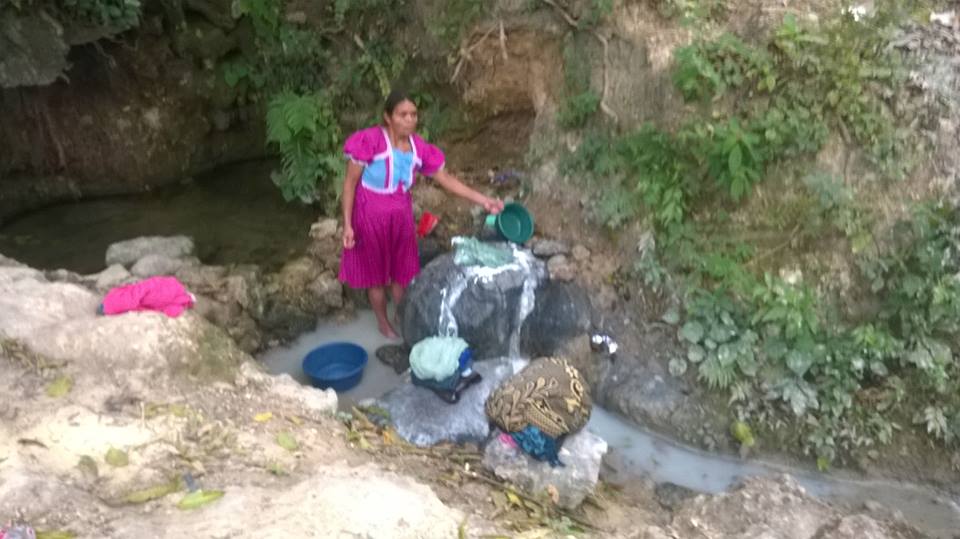
countries is the cleanliness of their formal dress.  Living in mud huts in dry and/or rainy conditions it is beyond belief how they maintain their traditional dress spotless.  We visited villages on a Sunday and everyone had on their sparkling Sunday best.

This concludes thoughts and reactions after a week in Guatemala and how it compares to living in Costa Rica.  Despite its flaws I’d still choose Costa Rica over Guatemala however the experience traveling there was refreshing and exciting.  It makes you thankful for what you’ve got too.  Costa Rica is a step above the rest.  What I saw in Guatemala compares to Nicaragua and Panama living conditions.  I’ve never been to Honduras or El Salvador but I would assume they are similar to Guatemala too.

As for getting back to sleep after resetting my alarm for 2am it didn’t really happen.  The adrenaline switch was on and shortly I would be on my journey.

UPDATE: The Fire Volcano (volcan del fuego) located just 45km from Guatemala city began erupting heavily today.  They closed the international airport this afternoon so we just lucked out having flown back on the third.